Attractor Based Evolution Talk At Sussex University
18 June 2010
On 18 June I gave a talk to the Life And Mind and Alergic groups at Sussex University. The talk was called "The Origin Of Life: A Network Oriented View", and subtitled "Attractor Based Evolution".The session went well, with some interesting discussion, which continued in the IDS bar afterwards.
The presentation slides are available in the 'Publications' section of this website.
SimSoup Module Designs Published
8 May 2010
High level design documentation for the following modules in the SimSoup simulation has now been published (see the SimSoup Design section of this website):
- Chemical Network
- Molecular Structure
- Reactor
Further design documentation will be published in due course. The immediate priority for the project is to perform some further testing of the model, as mentioned in the status update published on 2 January.
Update On Status and Outlook
2 January 2010
At the start of a new year, it seems to useful to set down some thoughts on the overall state of progress of SimSoup, and the prospects for the coming year.Recap Of Status
Artificial Chemistry Meets Pauling
The main focus last year was completing the incorporation of molecular structure. The primary objective was to make SimSoup more open ended. In previous versions, the types of molecules and the types of interactions (reactions) between them had been pre-specified. This meant that it was difficult to introduce novelty. In SimSoup 0.4, novelty was introduced by rewiring the reaction network as the simulation ran. This led to some interesting behaviour, but could hardly be said to be realistic. In real chemistry, the ways in which molecules can interact do not change; they are fixed for all time by the laws of chemistry and physics.The open-ended SimSoup model deals with this by introducing (two dimensional) molecular structure. New structures are formed by joining and splitting existing structures according to rules that are analogous to those of real chemistry, but which avoid unnecessary conceptual and computational complexity.
The first version of the open-ended SimSoup was working in April 2009; the model and some and preliminary results were presented in the paper “SimSoup: Artificial Chemistry Meets Pauling”. The paper is to be included in “Advances in Artificial Life”, the proceedings of ECAL 2009, last year’s European Conference on Artificial Life (follow the Publications link on the left to see the paper).
The conference itself was great, if a little haphazard. Its so good to meet like-minded people.
The following shows a selection of molecular structures produced in a preliminary run.
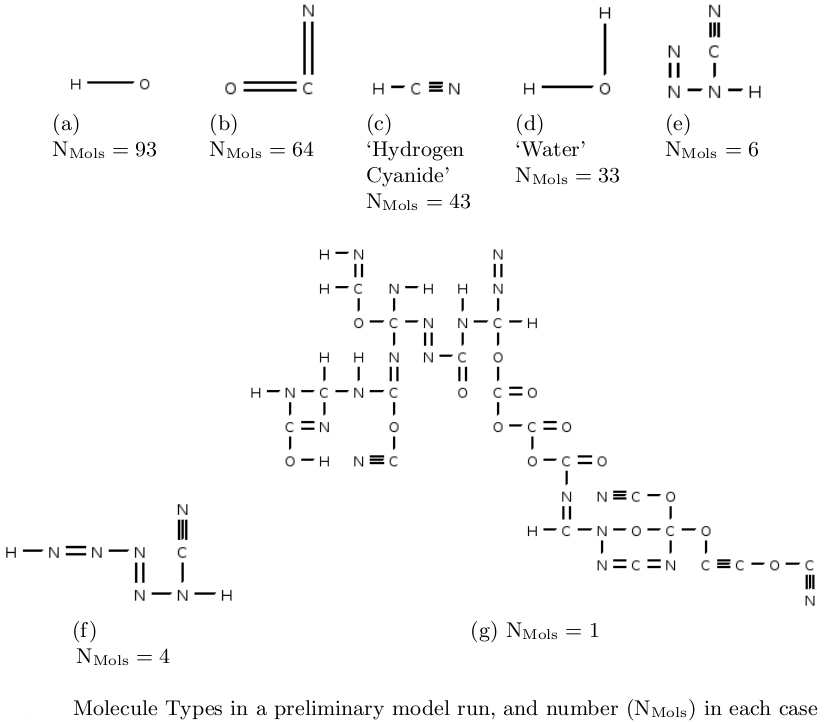
Why “Artificial Chemistry Meets Pauling”? This is a reference to Linus Pauling, whose book “The Nature Of The Chemical Bond” is a definitive text on molecular structure.
Levels of Selection Workshop at ECAL 2009
I attended the Levels of Selection and Individuality in Evolution Workshop at ECAL 2009. There were a number of interesting talks. The invited speaker, Eörs Szathmary gave a fascinating talk on the current status of research into the Major Transitions of Evolution.I had an ‘extended abstract’ that was included as a poster. Its called “The Origin Of Life: A Network Oriented View”.
Outlook For 2010
The main areas of attention will be:- Essential SimSoup model `housekeeping'
- Performance improvements
- Release SimSoup Version 0.5
- Further investigations using SimSoup.
Housekeeping: This will include improving the documentation, improving and simplifying the code where necessary, and further testing of the model.
I envisage SimSoup as a project that will continue to develop; the documentation and code improvements are necessary to ensure the code continues to be maintainable. I am using MetaPost for producing diagrams; there is a learning curve, but now that I have some basic macros it is possible to produce high quality diagrams fairly quickly. The ‘SimSoup Design’ part of this website is being updated on an ongoing basis as documentation is produced.
Although all of the SimSoup code has been tested, much of this testing has been ad hoc, and carried out as the code was developed. I want to be able to be fully confident that the results produced by the model are ‘real’, and not something produced as a result of a bug or some other unintended feature.
Performance Improvements: The logic introduced to split and join Molecule Types is computationally intensive. Some performance improvements have already been made, but it will be worth spending some more effort to get further improvement.
Release SimSoup Version 0.5: Once the essential housekeeping is complete, I want to release the open-ended SimSoup model as Version 0.5. The code has already been available for several months on Google Code, but as developmentt code rather than as a stable release.Further Investigations Using SimSoup: In the few preliminary runs of open-ended SimSoup conducted so far, I have not seen anything that suggests a system capable of evolution. There is much more to be done in running the model under different conditions.
One suggestion made to me by Pietro Speroni di Fenizio is that the SimSoup chemistry may result in a chemistry that is too complex. I think this is an interesting idea. The open-ended SimSoup model certainly allows great complexity, and can generate a very large number of different Molecule Types. Perhaps the possibilities need constraining in some way in order for ‘interesting’ behaviour to occur. This idea appeals to me, at least on an intuitive basis.